
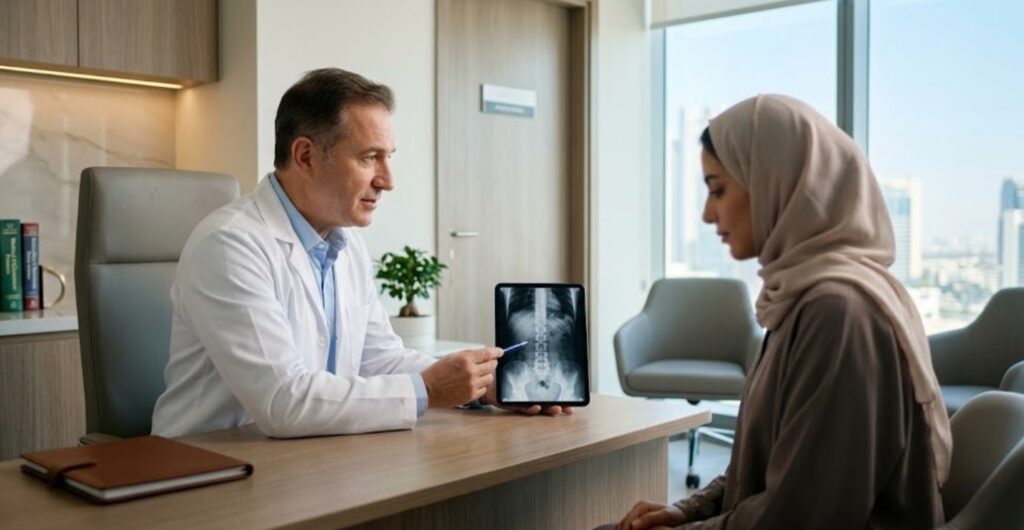
If you or your child has been told there is a curve in the spine, one of the first questions is often, “Which doctor treats scoliosis?”
A scoliosis doctor is usually an orthopaedic specialist with experience in spinal conditions. For more complex cases, especially when surgery may be considered, an orthopedic spine surgeon can assess the spine and explain the available treatment options.
Scoliosis is more than simply having a curved back. The spine can bend sideways and may also twist. Some people have a small curve that only needs monitoring, while others may need physiotherapy, bracing, or surgery.
At Dr Micheal Spine Surgeon in Dubai, the focus is on understanding the patient’s condition before deciding which treatment may be suitable.
What Is Scoliosis?
Scoliosis is a condition where the spine develops an abnormal sideways curve. The spine may also rotate or twist.
Think of a straight line. If the line starts bending to one side, that gives a simple idea of what a spinal curve can look like.
Scoliosis is often found in children and teenagers, particularly during periods of rapid growth. Adults can also have scoliosis. Some adults have had the condition since childhood, while others develop spinal curvature because of age-related changes in the spine.
Some people have no symptoms. Others may experience:
- Uneven shoulders or hips
- One shoulder blade appearing more prominent
- A visible curve in the back
- Back pain
- Changes in posture
- Numbness or weakness in some cases
- Leg pain in some adults
Having scoliosis does not automatically mean you need surgery. Many people with scoliosis only need observation or non-surgical treatment.
Which Doctor Treats Scoliosis?
An orthopedic spine surgeon is a specialist who treats conditions affecting the spine, including scoliosis and other spinal deformities.
For children and teenagers, a paediatric orthopaedic specialist may also be involved. Depending on the patient’s needs, treatment may include other healthcare professionals.
| Specialist | How They May Help |
|---|---|
| Orthopedic spine surgeon | Assesses spinal curves and manages complex or surgical cases |
| Paediatric orthopaedic specialist | Treats spinal conditions in children and teenagers |
| Physiotherapist | Helps with movement, strength and pain management |
| Orthotist | Helps with certain types of spinal braces |
The Scoliosis Research Society recognises orthopaedic surgeons among specialists who treat scoliosis and spinal deformities.
If you are looking for a scoliosis doctor in Dubai, consider the doctor’s training and experience with spinal conditions rather than choosing based only on the word “scoliosis” in a profile.
How Is Scoliosis Diagnosed?
A scoliosis assessment normally starts with a discussion about symptoms, medical history and when the spinal curve was first noticed.
The doctor may examine the patient’s posture, shoulders, hips and back. They may also ask the patient to bend forward or walk so they can assess the spine and movement.
An X-ray is commonly used to examine the spine and measure the curve. Doctors may use a measurement called the Cobb angle to describe the size of a scoliosis curve.
For children who are still growing, follow-up appointments may be needed because the curve can change as the child grows.
An MRI may be recommended in certain situations. It can provide a closer look at the spinal cord and surrounding tissues when the doctor believes further investigation is needed.
Does Every Person With Scoliosis Need Treatment?
No.
This is one of the most important things to understand about scoliosis.
A small curve may only require regular monitoring. The doctor may recommend follow-up appointments to check whether the curve is changing.
Treatment decisions can depend on:
- The size of the curve
- The patient’s age
- Whether the patient is still growing
- Whether the curve is progressing
- Pain or other symptoms
- The location and shape of the curve
- Overall health
Children who are still growing require special attention because their spinal curve may change during growth.
What Treatments Are Available for Scoliosis?
There is no single treatment that works for every patient. The treatment depends on the person’s condition.
Observation
Some people with mild scoliosis do not need active treatment.
Instead, the doctor may recommend regular examinations and imaging to monitor the curve.
This can be suitable when the curve is small and there are no serious symptoms.
Physiotherapy and Exercise
Physiotherapy can help some patients improve strength, movement and posture. It may also help with managing pain.
Exercise does not automatically straighten every scoliosis curve. However, staying active can support overall health and help some people manage their symptoms.
Exercises should be selected according to the patient’s condition rather than simply copying exercises found online.
Bracing
Bracing may be recommended for certain children and teenagers who are still growing.
A brace is generally used to help stop a spinal curve from becoming worse while the child grows. It does not mean that the spine has been permanently straightened.
The type of brace and how long it should be worn depend on the individual patient.
Surgery
Surgery may be considered for some patients with larger or progressive curves, particularly when other treatments have not provided enough benefit.
One common procedure is spinal fusion. During this operation, selected vertebrae are joined so they heal into a solid section of bone. Screws and rods may be used to support the spine while it heals.
However, having scoliosis does not automatically mean that surgery is required.
For adults, the decision may also depend on other problems such as arthritis, nerve pressure, disc problems and spinal balance.
Scoliosis in Children vs Adults
Age is an important part of scoliosis treatment.
Children and Teenagers
A child’s spine is still growing, so doctors need to consider both the current curve and the possibility of future changes.
Some children only need observation. Others may benefit from bracing, while more severe or progressing curves may require surgical treatment.
Adults
Adult scoliosis can have different causes.
Some adults have had scoliosis since childhood. Others develop spinal curvature as the discs, joints and bones of the spine change with age.
Adult back pain may not come from scoliosis alone. Arthritis, disc problems or pressure on nerves can also cause symptoms.
For this reason, an adult scoliosis assessment should look at the complete condition of the spine rather than only the visible curve.
When Should You See a Scoliosis Doctor?
Consider seeing a specialist if you notice:
- Uneven shoulders
- Uneven hips
- A visible curve in the back
- One shoulder blade sticking out more
- Persistent back pain
- Changes in posture
- Numbness or weakness
- A child’s back changing during growth
- A previously diagnosed curve that appears to be getting worse
Scoliosis does not always cause pain, especially in children. Getting an assessment can help determine whether monitoring or treatment is needed.
How to Choose a Scoliosis Doctor in Dubai
When searching for a scoliosis doctor in Dubai, consider the doctor’s experience with spinal conditions and scoliosis.
Look for:
- Spine-specific expertise
The doctor should have appropriate training in orthopaedic and spine care. - Experience with scoliosis
Scoliosis can be different from ordinary back pain and may require specialised assessment. - Proper diagnosis
The doctor should consider the curve, symptoms, age, growth and medical history. - Different treatment options
Not every patient needs surgery. Observation and non-surgical treatment may be appropriate in many cases. - Individual treatment planning
Every spinal curve is different, so treatment should be based on the patient’s specific condition.
Get a Scoliosis Assessment in Dubai
If you have noticed changes in your child’s posture, have been diagnosed with scoliosis, or are experiencing problems related to an adult spinal curve, a professional assessment can help you understand what is happening.
A scoliosis doctor can examine the spine, review appropriate imaging and explain possible treatment options.
At Dr Micheal Spine Surgeon in Dubai, patients can seek specialist evaluation for scoliosis and other orthopaedic spine conditions.
Treatment is not always surgery. Some patients may only need monitoring, while others may benefit from physiotherapy, bracing or surgical treatment.
The first step is understanding the condition and choosing a treatment plan based on the patient’s individual needs.