
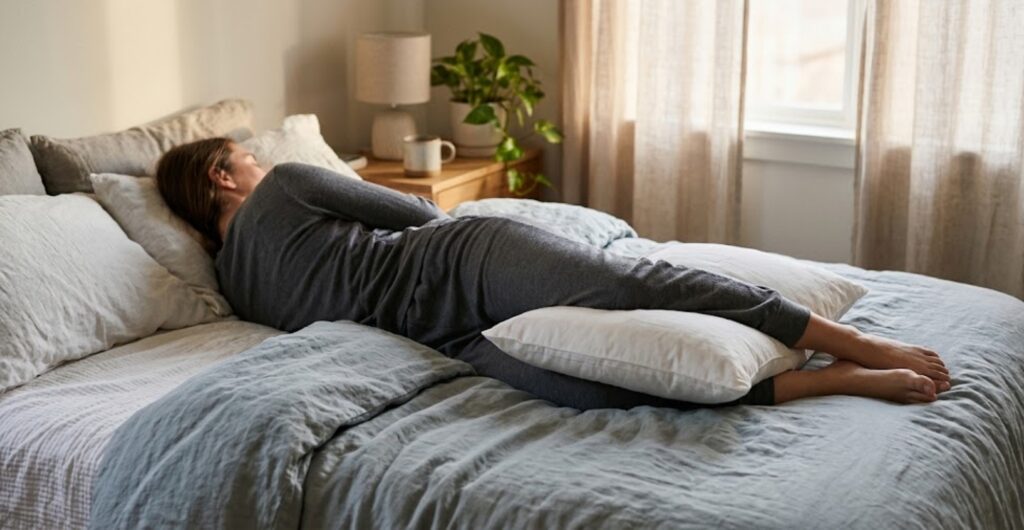
You finally get into bed after a long day, hoping to get some rest. But as soon as you lie down, a sharp pain travels from your lower back into your buttock and leg. You turn to one side, then the other, but nothing seems comfortable.
If this sounds familiar, sciatica may be affecting your sleep.
Finding the right sciatica sleeping position can help reduce discomfort and make it easier to rest. Small changes, such as placing a pillow between your knees or supporting your lower back, may make a difference.
Let’s look at which sleeping positions are worth trying, what may make your pain worse and when you should see a spine specialist.
Start Here: Which Sleeping Position Should You Try Tonight?
If you have sciatica, you do not need an expensive bed or complicated equipment to improve your sleeping comfort.
Start with these three positions:
| Sleeping position | How to position your body | Why try it? |
|---|---|---|
| Side sleeping | Place a pillow between your knees | Helps support your hips and pelvis |
| Back sleeping | Place a pillow under your knees | May reduce tension in your lower back |
| Reclined sleeping | Raise your upper body slightly | May help if lying flat increases pain |
The best position depends on your spinal condition. Try one position at a time and notice whether your leg pain improves or increases.
Option 1: Sleep on Your Side With a Pillow Between Your Knees
This is a useful starting position for many people with sciatica.
Lie on your side with your knees slightly bent. Place a pillow between them to prevent your upper leg from pulling your pelvis forward.
Keep your shoulders and hips facing the same direction.
This position supports pelvic alignment and may reduce unnecessary twisting around your lower back.
You can also use a full-length body pillow if you find it difficult to maintain this position throughout the night.
Option 2: Sleep on Your Back With a Pillow Under Your Knees
If you prefer sleeping on your back, try placing a pillow under both knees.
This slightly bends your hips and knees, which may make your lower back more comfortable.
Keep your head supported with a suitable pillow and avoid forcing your lower back completely flat.
This position may help people who experience discomfort when lying with their legs straight.
Option 3: Try a Slightly Reclined Position
Some people find lying completely flat uncomfortable.
A slightly reclined position may help, particularly if bending forward reduces their symptoms.
You can use an adjustable bed or a supportive recliner. Make sure your lower back, neck and upper body remain supported.
The Sleeping Positions That May Make Sciatica Worse
Not every sleeping position provides the same comfort. Some can increase pressure around an already irritated nerve.
Stomach sleeping: Lying on your stomach may increase the arch in your lower back. It also forces you to turn your neck to one side, which can cause additional discomfort.
Sleeping with twisted hips: Keeping one leg far in front of the other may rotate your pelvis and create discomfort around your lower back.
Sleeping on an unsupportive mattress: A mattress that is too soft may allow your hips to sink, while an excessively firm surface may create pressure around your shoulders and hips.
You do not necessarily need to avoid every position completely. Pay attention to how your symptoms respond and change positions when discomfort increases.
Why Does Sciatica Hurt More When You Lie Down?
Many people notice that their sciatica is manageable during the day but becomes worse at night.
There are several possible reasons.
Less distraction: During the day, you are busy with work and daily activities. In a quiet bedroom, you may become more aware of the pain.
Prolonged positioning: Staying in one position for several hours may increase pressure on a sensitive nerve root.
Nerve irritation: Conditions such as a herniated disc can irritate nerves in the lumbar spine, causing pain, tingling or burning sensations.
Mattress problems: Poor mattress support may affect your sleeping posture and increase discomfort.
Stress, anxiety and disrupted sleep can also make pain harder to manage. Although cortisol is involved in the body’s stress response, there is no established rule that a drop in cortisol at midnight directly causes sciatica pain.
What If You Only Experience Pain at Night?
If your pain appears mainly when lying down, your sleeping position may be triggering symptoms from an existing spinal condition.
For example, some people with spinal stenosis feel better when bending forward slightly. Others with disc-related problems may find certain bending positions uncomfortable.
Persistent nighttime pain should be assessed, especially if it is getting worse or is accompanied by numbness or weakness.
First, Understand What Is Causing Your Sciatica
Sciatica is not a disease itself. It describes pain caused by irritation or compression of the sciatic nerve or its nerve roots.
The sciatic nerve starts in the lower back and travels through the buttocks and down the legs.
When a nerve becomes irritated, you may experience:
- Shooting pain travelling down one leg.
- Burning or tingling sensations.
- Numbness in the foot or leg.
- Muscle weakness.
- Lower-back and buttock discomfort.
Some common causes include:
| Spinal condition | What happens? |
|---|---|
| Herniated disc | A damaged disc presses against a nearby nerve. |
| Spinal stenosis | The space around the spinal nerves becomes narrow. |
| Degenerative disc disease | Changes in spinal discs may contribute to nerve irritation. |
| Spondylolisthesis | One spinal bone slips forward over another. |
| Piriformis-related irritation | The muscle in the buttock may irritate the sciatic nerve. |
Understanding the cause matters because the best sleeping position and treatment may differ from one condition to another.
5 Practical Changes That Can Make Bedtime More Comfortable
Changing your sleeping position is a good starting point, but your daytime habits also matter.
Here are five practical changes to consider.
1. Check Your Mattress
A medium-firm mattress is a reasonable starting point for people with lower-back pain.
It should support your body without allowing your hips to sink too deeply.
However, mattress firmness is personal. Choose a surface that keeps you comfortable and supports your natural spinal alignment.
2. Use Heat or Cold Before Bed
A warm pack may help relax tight muscles around your lower back.
Cold therapy may provide temporary relief during a painful flare-up.
Apply heat for around 15 to 20 minutes or a wrapped cold pack for 10 to 15 minutes. Never apply either directly to your skin, particularly if you have reduced sensation.
3. Walk Before Going to Bed
A short, gentle walk may help reduce stiffness after sitting for long periods.
You can also try comfortable stretching if it does not increase your leg pain.
Avoid aggressive exercises or stretches that cause shooting pain, tingling or numbness.
4. Change Your Sitting Habits
Long sitting periods can aggravate sciatica in some people.
If you work at a desk, stand up and move every 30 minutes. Use a supportive chair and avoid keeping bulky objects, such as a wallet, in your back pocket.
5. Avoid Complete Bed Rest
Rest may help during severe pain, but staying in bed for several days can lead to muscle weakness and reduced mobility.
Try gentle daily activities, such as walking, within your comfort level.
When Is It Time to See a Spine Specialist?
Occasional sciatica discomfort may improve with suitable positioning and conservative treatment.
However, you should arrange a medical assessment if:
- Pain continues for several weeks.
- Your symptoms become progressively worse.
- You experience persistent numbness or tingling.
- Your leg becomes weak.
- Pain regularly interrupts your sleep.
- You have difficulty walking or performing everyday activities.
A spine specialist may examine your movement, muscle strength, reflexes and sensation.
An MRI may be recommended when imaging is needed to investigate suspected nerve compression or guide treatment. Not everyone with sciatica requires a scan.
What Treatments Are Available for Persistent Sciatica?
Treatment depends on the cause and severity of your symptoms.
Medication: A doctor may recommend selected pain-relief or anti-inflammatory medicines. These are not suitable for everyone and may have side effects.
Physical therapy: A personalised exercise programme can improve movement, strength and flexibility.
Epidural injections: Selected patients may benefit from steroid injections around the affected spinal nerves for short-term relief.
Surgery: If a herniated disc or another condition continues to compress a nerve, surgical procedures such as discectomy or spinal decompression may be considered.
Surgery is not required in most cases. A specialist will assess whether its potential benefits outweigh the risks.
Warning Signs You Should Never Ignore
Some sciatica symptoms require emergency medical attention.
Seek emergency care immediately if you experience:
- Numbness around your genitals or anus.
- New difficulty passing urine or inability to urinate.
- Loss of bladder or bowel control.
- Severe or worsening weakness in both legs.
These symptoms may indicate cauda equina syndrome, which occurs when nerves at the bottom of the spinal canal become severely compressed.
Delaying treatment can cause permanent nerve damage.
Frequently Asked Questions
What is the best sleeping position for sciatica?
Side sleeping with a pillow between your knees and back sleeping with a pillow underneath your knees are two useful positions to try.
Should I sleep on the painful side or the opposite side?
It depends on your symptoms. Some people prefer the opposite side to avoid direct pressure, while others find the painful side more comfortable.
Is stomach sleeping bad for sciatica?
It may increase lower-back discomfort in some people. Try side or back sleeping if stomach sleeping makes your symptoms worse.
How long does sciatica take to heal?
Many people begin improving within 4 to 6 weeks. Recovery depends on the cause and severity of nerve irritation.
Can a pillow cure sciatica?
No. A pillow may improve comfort and support your spine, but it cannot remove an underlying herniated disc or correct spinal stenosis.
Get the Right Help for Persistent Sciatica Pain
Finding a comfortable sleeping position can make nights easier, but persistent sciatica needs more than pillow adjustments.
If pain continues, affects your sleep or causes numbness and weakness, identifying the underlying spinal condition is important.
At Dr Micheal Spine Surgeon in Dubai, patients can seek specialist assessment for sciatica, herniated discs, spinal stenosis and other spinal conditions.
The right diagnosis helps determine whether you need medication, physical therapy, injections or a surgical opinion.
Don’t ignore persistent nerve pain. Seek medical advice to understand its cause and discuss suitable treatment options.